
New Foothills Chapter
By Brenda Thomas reporting for Native Plant News Summer 2026
When I moved to western North Carolina from southwest Florida two years ago, I knew I wanted to connect with people with whom I could explore the local forests and from whom I could learn the native flora. I had spent two decades in Florida working in environmental education and doing botanical research so I knew those ecosystems well. Because there was not a native plant society chapter in the foothills region where I now live in Lenoir, I brought together a group of people as a steering committee who could work with me to start one. What better way to make plant peep friends?
The Foothills region includes the counties of Alexander, Burke, Caldwell, Catawba, Cleveland, Lincoln, McDowell, Polk, Rutherford, and Wilkes. Our steering committee is as diverse as the plants of the Foothills—we are teachers and learners, small business owners, musicians, master gardeners, and conservationists—and we all share a strong desire to support our local community and to show our neighbors the benefits and beauty of native plants. Because we are sandwiched between the mountains of western North Carolina and the bustling Piedmont to the east, the Foothills are often overlooked. We hope to change that.
From our first conversation, the steering committee members were in agreement that we wanted the Foothills Chapter to focus on education. The group senses that there is a large gap in knowledge and understanding about native plants and the benefits that they bring to our human landscapes. The region’s expanding population does not always understand North Carolina’s climate and other growing conditions, let alone our native plant species. However, we also recognize a growing national interest in attracting birds and pollinators, especially butterflies, to our built landscapes. We see this as an opportunity for our chapter to teach aspiring bird and butterfly enthusiasts exactly how to do that. Our overarching goal then is to encourage our neighbors to keep the nonnative species out of the woods and teach them how to bring the woods into their yards.
We are in the early stages of organizing the year to come, but are planning hikes to get people out into the woods so they can fall in love with the natural environments of the region and educational events to help them put that passion into practice in their own backyards. Our events will initially center around the Morganton area in Burke County, just because that is where our steering committee members are from. Our goal though is for the chapter’s programs to reach from one end of the foothills to the other.
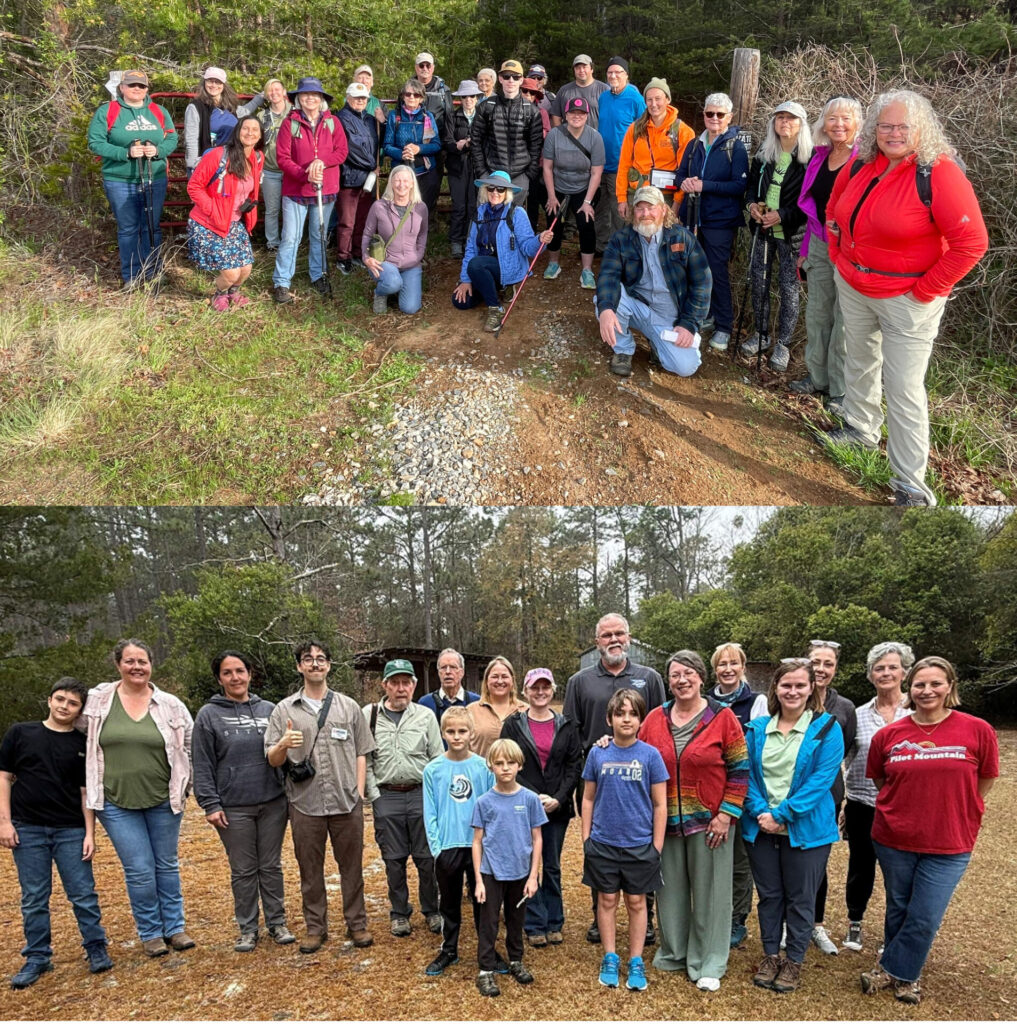
Last April, close to 30 people attended our inaugural event, a hike to the Smith Cliffs property owned by the Foothills Conservancy in Morganton and led by Biologist Jess Schaner of the N.C. Natural Heritage Program who spoke about the rare plants. Participants learned about the work of the Foothills Conservancy from Stewardship Director Ryan Sparks. It was a beautiful morning for a walk in the woods and many of the chapter’s steering committee members were in attendance. As I hoped I have found plant peeps to play in the woods with me!
Brenda earned a masters degree in environmental science and her doctorate in education. She has worked for most of her adult life in formal and informal environmental education. Before moving to North Carolina, she volunteered extensively with the Herbarium of Southwestern Florida, housed at Naples Botanical Garden, conducting data entry and plant collecting with curator Dr. George Wilder, with whom she has conducted and coauthored several floristic inventories of natural areas in Florida.
New Sandhills Chapter
By Namaste Arey and Cami Gregg reporting for Native Plant News Summer 2026
The Sandhills Chapter became the tenth chapter of the NCNPS on Valentine’s Day, February 14th, 2026. What better day to show our love for the Sandhills and native plants!
The Sandhills is nestled between the Piedmont and Coastal Region of North Carolina and oftentimes overlooked as a distinct part of the Coastal Plain. The region includes the counties of Anson, Cumberland, Harnett, Hoke, Lee, Montgomery, Moore, Richmond, and Scotland. It is characterized by a rolling topography and its very unique sandy soils; and it has a longer history of controlled burning due to the long leaf pine and wiregrass eco-system that requires fire. Within its approximately 1 million acres, it supports 40% of the biodiversity in NC and “may well be the most diverse North American ecosystem north of the tropics, containing rare plants and animals not found anywhere else,” as stated by The Wildlife Society.
The Sandhills Chapter has a 10-person steering committee that is made up of native plant nursery owners, landscape designers, a prescribed burn expert, county extension horticultural agents, farm owners, and as a bonus we have Bruce Sorrie as our mentor/advisor.
We have a busy year planned and kicked off our new Sandhills Chapter last March with 125 attendees! Our plans include attending many festivals throughout our nine counties; two guided field trips; a native garden tour; an August meeting to celebrate the 75th Anniversary; a native plant sale; plant rescue work; and a propagation program for 10 Sandhill species based on their importance in the Sandhills ecosystem.
The Sandhills Chapter is excited to be a part of the NCNPS and we are off to a great start!
Namaste Arey grew up in the foothills of North Carolina and followed her love of the outdoors to the Sandhills. She settled in Moore County in the mid-1990s to study horticulture at Sandhills Community College. With over 30 years in the industry, she is the owner and grower at Meadowflower Farms, specializing in NC native plants. She balances farm life, a family of five, community service, and a deep commitment to local ecosystems.
Cami Gregg moved to North Carolina from Georgia in 2018 and started her love of native plants and the Sandhills after discovering many plants on her farm that she could not identify. She used the NCNPS website to help with identifying, then worked to certify her yard, and continued to plant natives and find more natives to continue adding to the list. In her spare time, she loves spending time with her two dogs, June Bug and Hank, and of course most of the time is in her garden/yard.