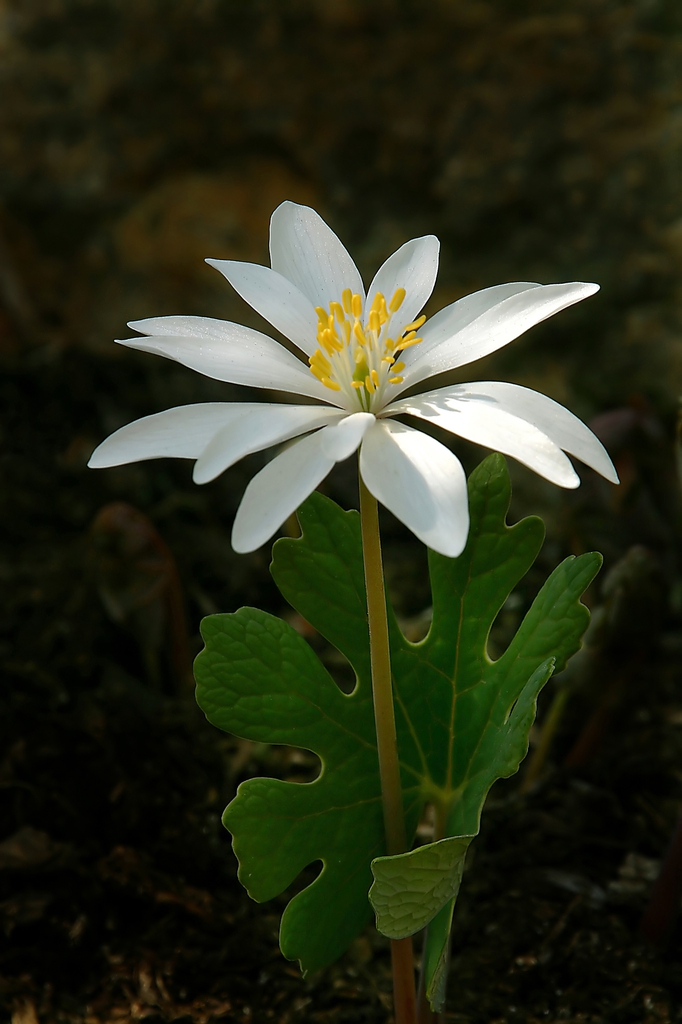
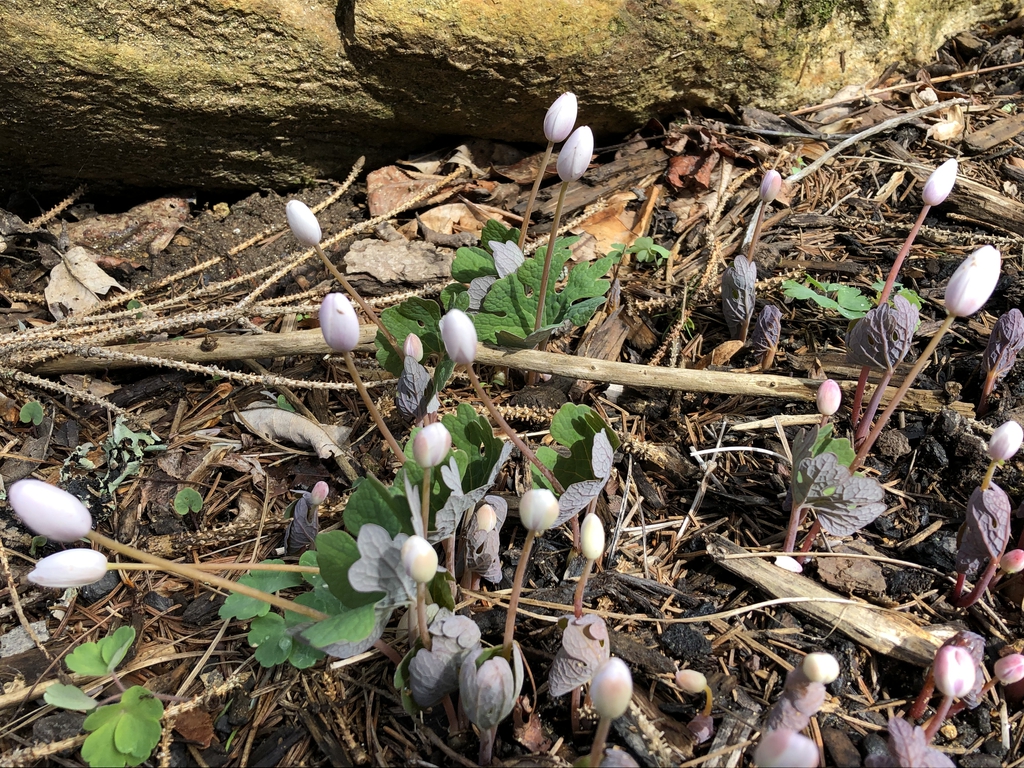
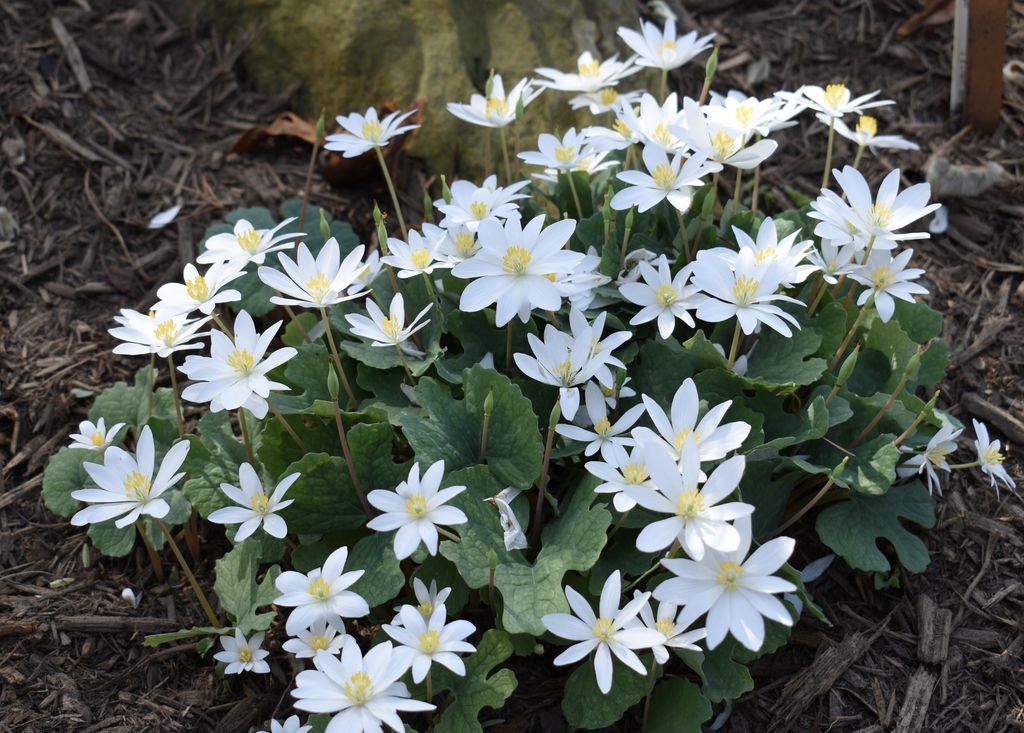
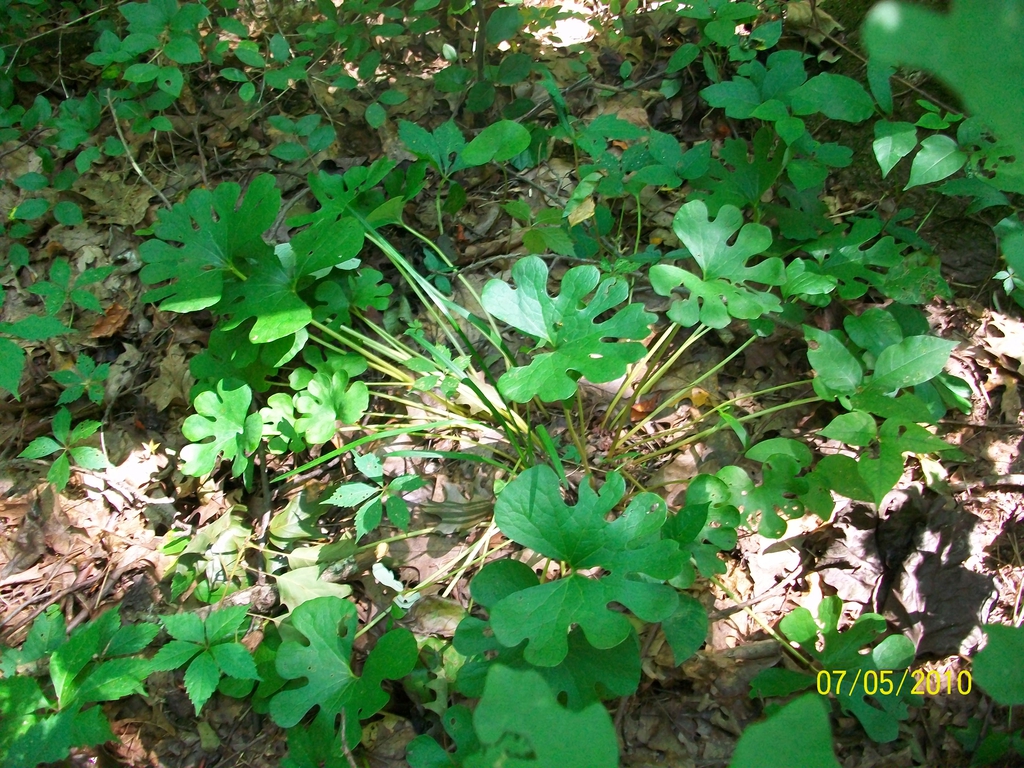
The flower only lasts a few days, while the leaves may last until August with adequate moisture. This reminds me of the “Dennis the Menace” movie where Mr. Wilson waits for the 36-hour bloom of the Corpse Flower (Amorphophallus titanium) only to have it ruined by Dennis. You had better get to the field or you may miss out on Bloodroot flowers. Please include children in flower searches and feel free to use this as an excuse to skip work.
The flower is hermaphroditic with male and female parts. The first couple of days a flower is open, the stamens remain above the stigma (female flower part) and insects serve as pollinators. The pollinators are primarily mining bees, sweat bees, honeybees, and carpenter bees although beetles can also get the job done. The attractive flower plays a trick on the pollinators; there is no nectar. If pollination does not occur after a few days, the stamina (plural of “stamen”) will turn inwards and self-pollination will occur. Editor’s note: As with botanical and common plant names, things are always changing. At least four major botanical keys use “stamens” as the plural of “stamen.” Both stamina and stamens are correct.
After pollination, an elongated upright seed pod forms. The 1-inch-long capsule has two parts with 10 to 15 red to black seeds in each part. When the capsule matures, it dries and ruptures releasing the seeds. Bloodroot uses pollinators offering no reward except some pollen, but it is a bit more generous with seed dispersal. Each seed has a structure containing lipids and proteins called an elaisome. In a symbiosis called myrmecochory, ants are attracted to the elaisomes and carry the seed back to their colony. Ants consume the elaisome and deposit the seed into their trash heap. This seems like a bad deal for the seed, but they have been planted in a safe place with fertilizer. This is not an unusual strategy for low-growing plants that are not likely to be wind dispersed.
Bloodroot has been used as a dye by Native Americans for centuries, but there are medicinal uses also. The orange-red sap is most prolific in the rhizomes and includes large amounts of an alkaloid called sanguinarine. Sanguinarine can be toxic in large amounts, leading to nausea, vomiting, dizziness, and heart failure so caution must be used with the plant. Sanguinarine was added to toothpaste and mouthwash for a time due to its antimicrobial properties, but it is no longer added to products commercially used by humans. Even handling the rhizomes can cause skin reactions in some people.
Bloodroot can be found throughout the Carolinas but is more common in the Piedmont and Mountains. Its range includes most of eastern North America. If you have rich, moist acidic soil in full to partial shade, you may be able to grow Bloodroot in your yard. I think it is more fun to get out in the forest or park and see what you can find. I keep a list of plants I find by date and place so I can make sure I return the next spring to observe nature’s glory at its best. Near the top of my favorites list is the Bloodroot. It is like Christmas; you only get it a few days a year.
More information: https://www.srs.fs.usda.gov/pubs/gtr/gtr_srs086.pdf