
By Annkatrin Rose reporting for Native Plant News Spring 2026
Do you sometimes encounter strange things on your walks through the woods? I had one such moment during a wildflower pilgrimage hike in the Cosby area of the Great Smoky Mountains. Along the Cosby Horse Trail, we came across numerous white wormy strands covering the ground along and even right on the trail. They seemed botanical in nature, like roots growing the wrong way. Looking for wildflowers, we had stumbled over one of Mother Nature’s underground spring ephemeral secrets usually hidden out of sight!
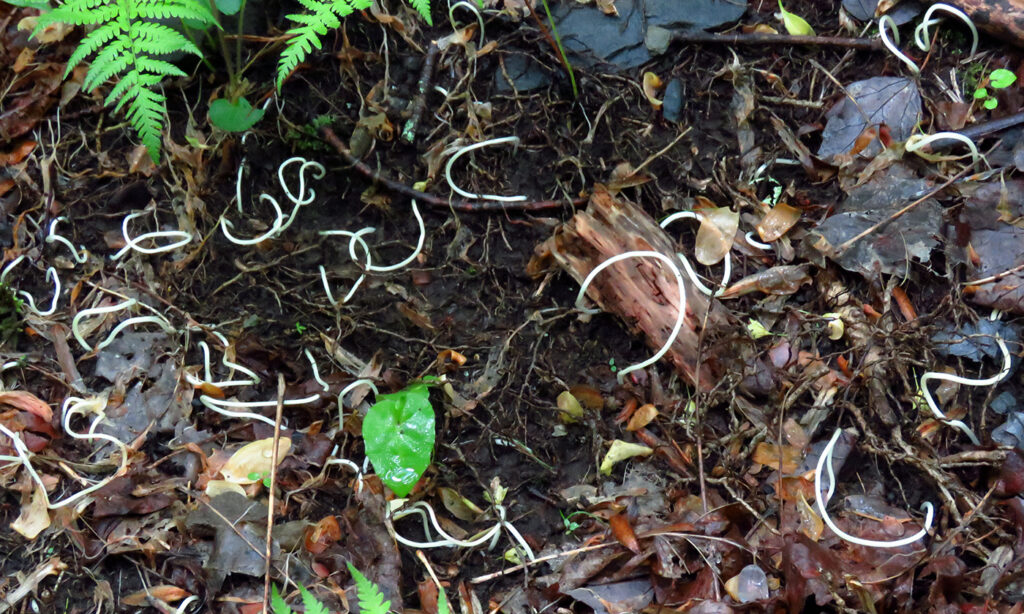
The mystery of the white wormy things
Fortunately, my knowledgeable co-leader Larry Klotz knew right away what we were looking at: Trout lily droppers. When the forest floor awakens in early spring, trout lilies (two species of Erythronium in North Carolina, E. americanum and E. umbilicatum) with their mottled leaves and nodding bright yellow flowers, are some of the earliest harbingers of spring. But their appearance as spring ephemerals is brief and this hike was in late April, already past their bloom time in this area. Only a few fading leaves were all that was left of them. They had emerged earlier in the year from an underground corm, a bulb-like organ that stores the energy needed to survive summer and winter underground and to fuel the spring growth spurt and bloom. Their droppers were everywhere though.
A dropper is a slender stem structure (like the runners on strawberry plants) that burrows downward from the parent corm and develops a new corm at its tip, digging up to eight times deeper into the soil in the process. Remarkably, corms closer to the soil surface produce droppers that dig deeper, demonstrating the plant’s ability to detect its depth and adjust the dropper length to achieve optimal depth. In this way, the new corm can escape potentially dangerous soil temperature fluctuations near the surface and persist for many decades in the same colony.
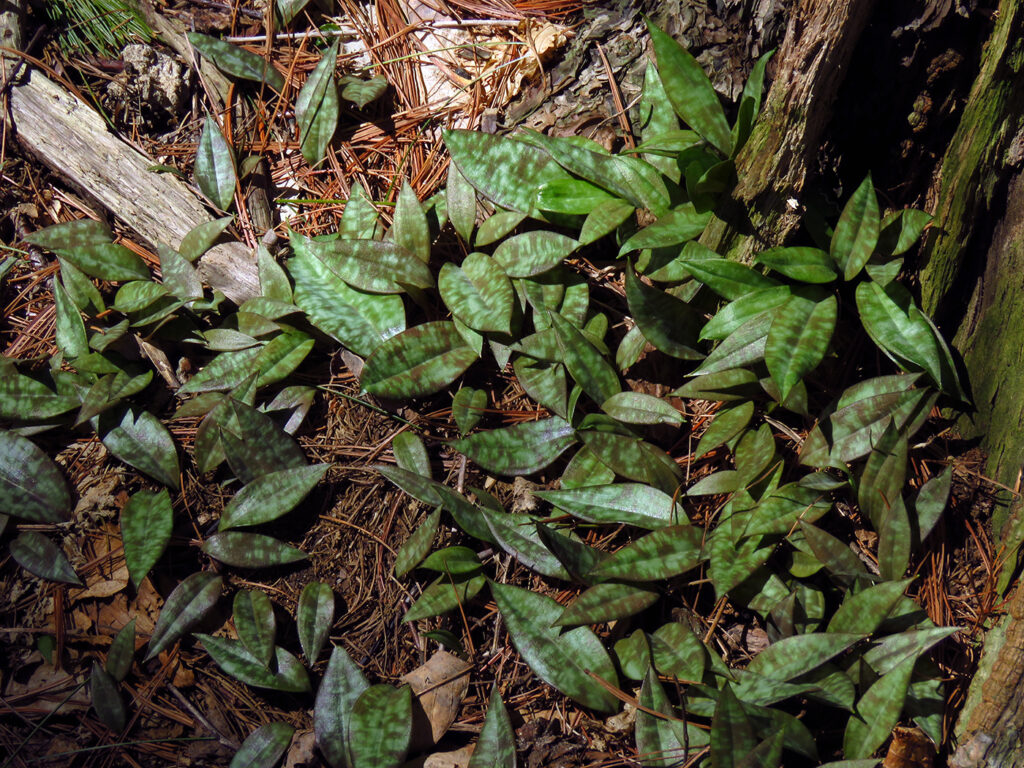
Droppers are so effective at vegetative reproduction that most trout lily colonies consist largely of non-flowering individuals produced this way. We have often wondered on our spring hikes in the mountains why a patch of trout lilies can carpet the forest floor yet show only a sprinkling of flowers. Flowering plants, with their two leaves, are rare: sometimes less than 1% of a colony blooms in a given year. And right here in front of us was the explanation! Soil conditions influence dropper behavior: in compacted soils near trails, droppers may even grow upward, placing new corms closer to the surface, which was exactly what we were seeing at our feet.
An unsolved pollination puzzle
Looking more into trout lily reproduction, their droppers are not the only surprising feature. The distinctive nodding yellow flowers of trout lilies serve as beacons on the forest floor, attracting early spring pollinators. Trout lilies depend on outcrossing for seed production, and artificially isolated flowers generally fail to set fruit. Their generous nectar and pollen rewards are a critical early-season resource for insect pollinators when few other blooms are available. Studies in North Carolina show that a variety of small bees are their most effective pollinators with one native specialist, the Trout lily Miner Bee (Andrena erythronii), emerging just in time to forage on these flowers. Larger bees and pollen-feeding beetles may contribute to pollen transfer as well.
One mystery of the trout lily flower has long puzzled scientists. Look closely at a patch of blooming trout lilies, and you might notice a striking color variation: Some flowers will have bright yellow anthers and pollen, while others will have orange-red, brick red, or even purple ones. This color variation, known as a polymorphism, is common in both species found in North Carolina and highly variable even within a single population. For E. umbilicatum in the mountains, the purple pollen morph is more frequent but not a reliable clue for species identification. So why do both colors coexist in wild trout lily populations?
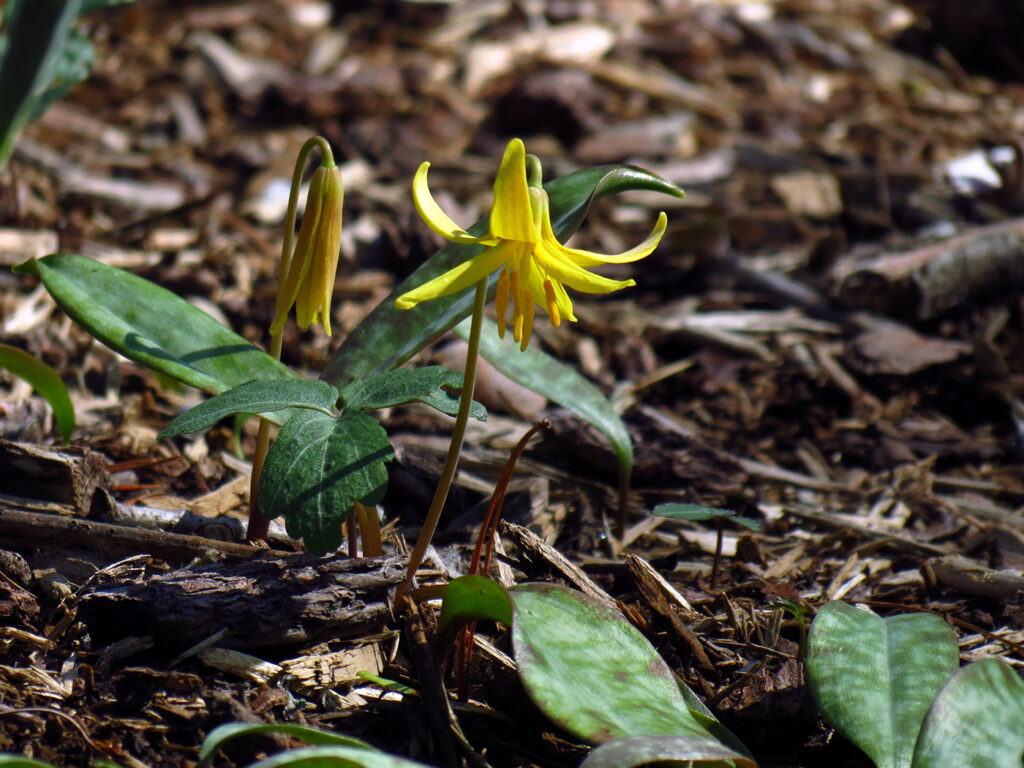
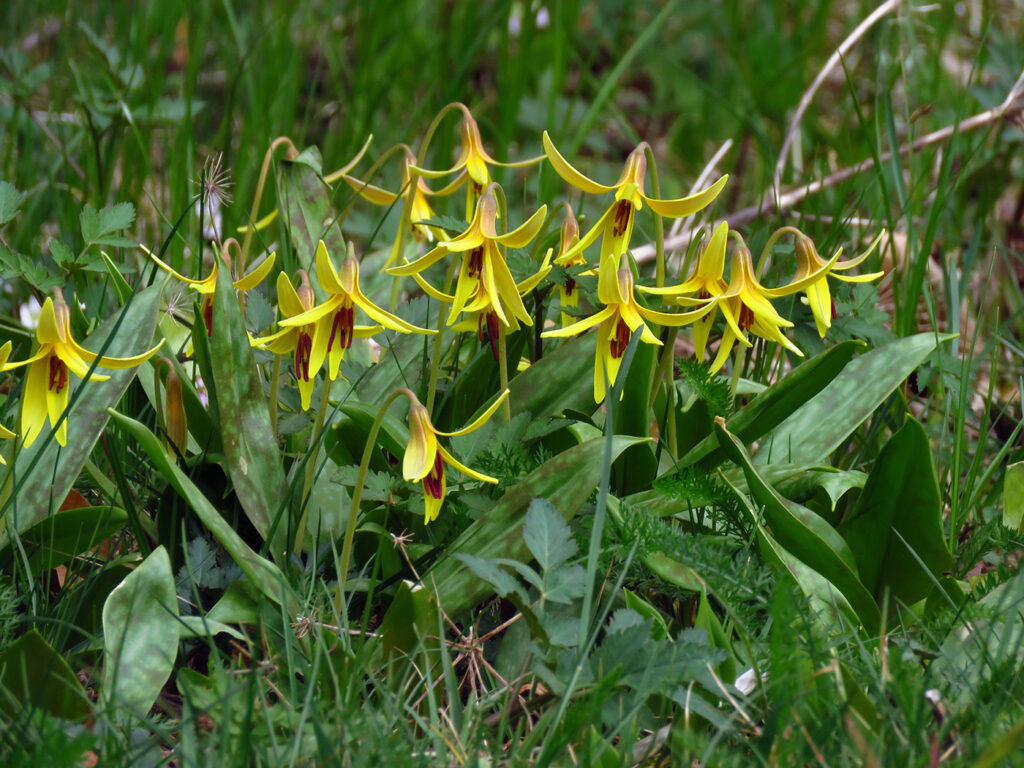
Researchers have explored several questions in search of an explanation for this phenomenon: Does the red-purple color, created by anthocyanin pigments, deter pollen-eating beetles? Does it offer better protection from damaging UV-B radiation? Does one color have more success in producing fruit? The answer to all of these questions has been a resounding NO. No clear ecological advantage has so far emerged for either pollen color in any of these functions. One tantalizing clue observed was that pollinators sometimes showed preferences for one color over the other, but these preferences varied by location and weren’t consistent. For now, trout lily pollen color variation remains an intriguing evolutionary puzzle.
Seeds on the move – with a little help
Fortunately, trout lilies don’t need many pollinator visits to succeed in reproduction. Just two or three visits from bees can fertilize all ovules in a flower, an advantage in habitats where floral visits may be scarce due to shortage of flowers, pollinators, or both. Still, seed set can be modest: in E. umbilicatum, only about 40–60% of ovules mature into seeds, and in E. americanum, fewer than 10% of flowers produce seeds in some populations. Weather, light, water, and nutrients often limit reproduction more than pollinator scarcity.
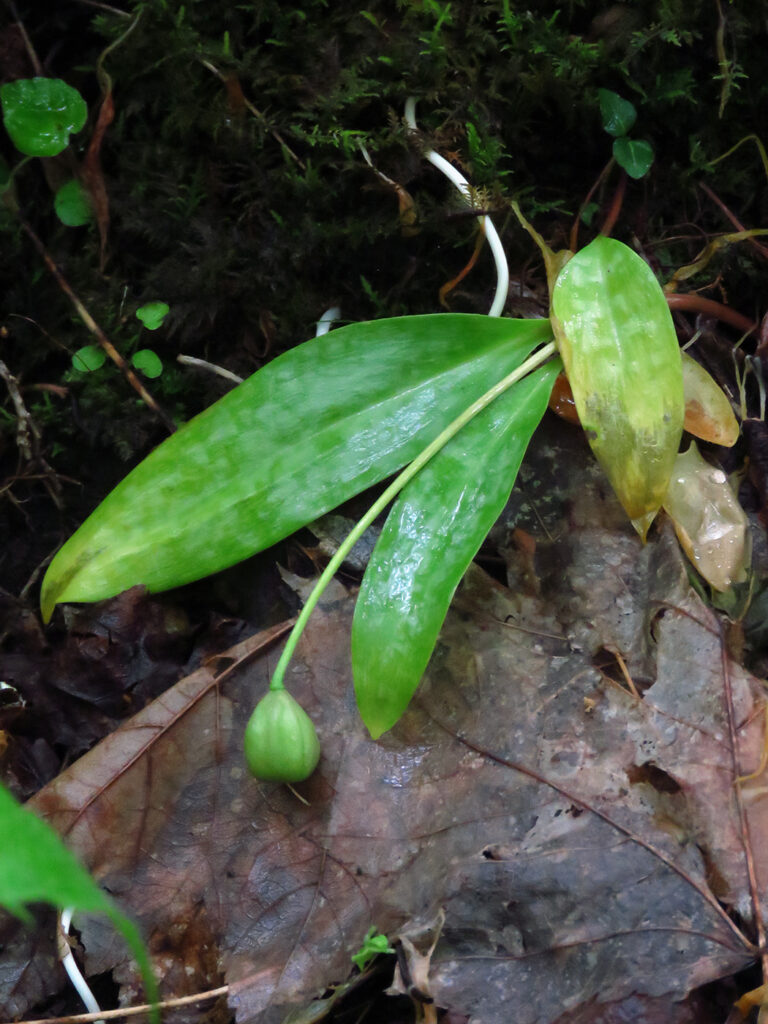
When seeds are produced, trout lilies enlist ants for dispersal in a strategy called myrmecochory. Each crescent-shaped seed bears an elaiosome, a fatty appendage irresistible to ants. The ants, primarily Aphaenogaster rudis in the case of the trout lily, collect and carry seeds to their nests, eat the elaiosomes, and discard the remaining seeds in underground middens. Trout lilies share this strategy with other early spring ephemerals, such as bloodroot, spring beauty, and trilliums, in our eastern deciduous forests.
This symbiotic relationship reduces the likelihood of seed predation by quickly removing seeds from the soil surface and depositing them in a nutrient-enriched safe site. Researchers have found that ants removed significantly more seeds than predators, such as rodents and nocturnal ground beetles, within the first 48 hours of seed exposure. Ant burial may also help seedlings survive the first winter by placing them at a sufficient depth to avoid freezing to death, especially under reduced snowpack scenarios, which might become more prevalent with climate change.
Survivors on the forest floor
The eye-catching blooms we appreciate on a spring walk are not just heralds of spring but a bid for survival and components of a larger ecosystem. A deeper look at the humble trout lily reveals a surprisingly adept survivor, one that engineers its own success through intricate partnerships both above and below ground: small bees buzzing in the cool spring air, ants hauling seeds underground, and droppers quietly extending into the soil to ensure that trout lilies return year after year. Their dual reproductive strategies—sexual and vegetative—illustrate resilience in a challenging environment where timing is everything.
An underground savings account
Another underground secret to the trout lily’s ability to grow and bloom in early spring lies in a symbiotic partnership with fungi and surrounding trees. The fungi connect the forest’s plant roots in a sort of “wood wide web” called mycorrhizae. This mycorrhizal network acts like a shared underground savings account for carbohydrates (sugars) produced during plant photosynthesis by the ephemeral understory plants and the dominant overstory trees.
This relationship has two distinct phases. In fall and winter, the fungi attached to trout lily roots are a net cost, drawing stored carbohydrates from the corm like parasites. Sugar maple saplings (which are still active in fall) transfer carbohydrates into the network, potentially balancing the loss and helping fund underground trout lily root growth and fungal colonization.
In the spring, the investment pays off handsomely as the symbiosis enters its mutualistic phase. Trout lilies are susceptible to water stress, and the fungal network becomes a massive benefit for the spring ephemerals through water uptake and sharing of nutrients (particularly phosphorus and potassium). The result is significantly better plant growth, sometimes twice that of non-mycorrhizal plants. As trout lily leaves are photosynthetic before the trees leaf out, they now share nutrients back with the surrounding sugar maple saplings. Researchers have been able to demonstrate the transfer of carbon 14 isotopes taken up by trout lily leaves to the saplings via the shared mycorrhizal network. In this way, trout lilies contribute to nutrient cycling through mycorrhizae and support sapling growth.
Winning the spring race against the trees
Spring ephemerals live their lives in a sprint, emerging, flowering, and fading back underground all within the few short weeks before the trees above leaf out and plunge the understory into shade. With global warming, the fear is that the trees will leaf out earlier and earlier, stealing precious days and weeks of sunlight from the spring wildflowers below—a phenomenon scientists call a “phenological mismatch.”
But recent research is revealing a far more complex and surprising story. In a fascinating twist, scientists have discovered that for the dimpled trout lily (E. umbilicatum), the exact opposite is happening. A study tracking flowering times and tree “green-up” found that the trout lily is actually more sensitive to warming temperatures than the overhead canopy: for every 1°C increase in average spring temperature, the trout lily’s peak bloom shifts 4.35 days earlier. The trees, in contrast, advance their leaf-out by only 1.3 days. What is going on?
The researchers discovered that the flower and the trees are listening to slightly different seasonal cues; the lily responds to the average temperature over three months (February-April), while the trees react more to the warmth in March alone. The result is a botanical surprise. Instead of the light window shrinking, it is projected to get longer by about 1.4 days every decade. It’s a classic underdog story written in petals and sunlight, and for now, this small flower is handily winning the race.
This closer look at trout lilies reminds us that survival in the forest often depends on unseen partnerships and remarkable strategies hidden just below our feet.
Citations
Austen, E. J., Lin, S. Y., & Forrest, J. R. K. (2018). On the ecological significance of pollen color: a case study in American trout lily (Erythronium americanum). Ecology, 99(4), 926–937. https://doi.org/10.1002/ecy.2164
Lerat, S., Gauci, R., Catford, J. G., Vierheilig, H., Piché, Y., & Lapointe, L. (2002). 14C transfer between the spring ephemeral Erythronium americanum and sugar maple saplings via arbuscular mycorrhizal fungi in natural stands. Oecologia, 132(2), 181–187. https://doi.org/10.1007/s00442-002-0958-9
Motten A. F. (1983). Reproduction of Erythronium umbilicatum (Liliaceae): pollination success and pollinator effectiveness. Oecologia, 59(2-3), 351–359. https://doi.org/10.1007/BF00378861
Ruhren, S. & Dudash, M.R. (1996). Consequences of the timing of seed release of Erythronium americanum (Liliaceae), a deciduous forest myrmecochore. American Journal of Botany, 83(5), 633-640. https://doi.org/10.1002/j.1537-2197.1996.tb12749.x
Schopler, M., Simha, A., Dalton, R. M., Wilson, E. M., Redick, E., Youngsteadt, E., & Petry, W. K. (2025). Spring ephemeral Erythronium umbilicatum may not be vulnerable to phenological mismatch with overstory trees. bioRxiv 2025.05.14.652260. https://doi.org/10.1101/2025.05.14.652260
Tessier J. T. (2012). Methods of belowground movement in Erythronium americanum. Northeastern Naturalist, 19(6), 77–88. https://www.eaglehill.us/NENAonline/articles/NENA-sp-6/15-Tessier.shtm

Annkatrin Rose is the current chair of the Blue Ridge Chapter in Boone, where she has been teaching botany at Appalachian State University for the past 20 years. She has a PhD in Plant Molecular Biology and conducts research on endophytes – microscopic fungi living inside plants – with several of her students receiving grants through the Shinn Fund from the NC Native Plant Society. She is a passionate observer of nature with over 10,000 observations on iNaturalist (https://www.inaturalist.org/people/annkatrinrose).