The Cassius Blue butterfly (Leptotes cassius) is a rare sight in North Carolina; Jeffrey Pippen documented it. Jeffrey S. Pippen, www.jeffpippen.com
By Carol Peoples reporting for Native Plant News Winter 2025
After I developed some habitats and conserved natural areas in my coastal North Carolina yard, a rarely seen butterfly found its way there.
In late August, Rachel Veal, conservation horticulturist with the North Carolina Aquarium on Roanoke Island, came for a visit to Emerald Isle. She made an exciting discovery! Amongst the variety of native bees, skippers, wasps, flies, and other butterflies that use my yard as habitat, she spotted a Cassius Blue butterfly (Leptotes cassius) nectaring on the flower of a Trailing Fuzzybean (Strophostyles helvola).
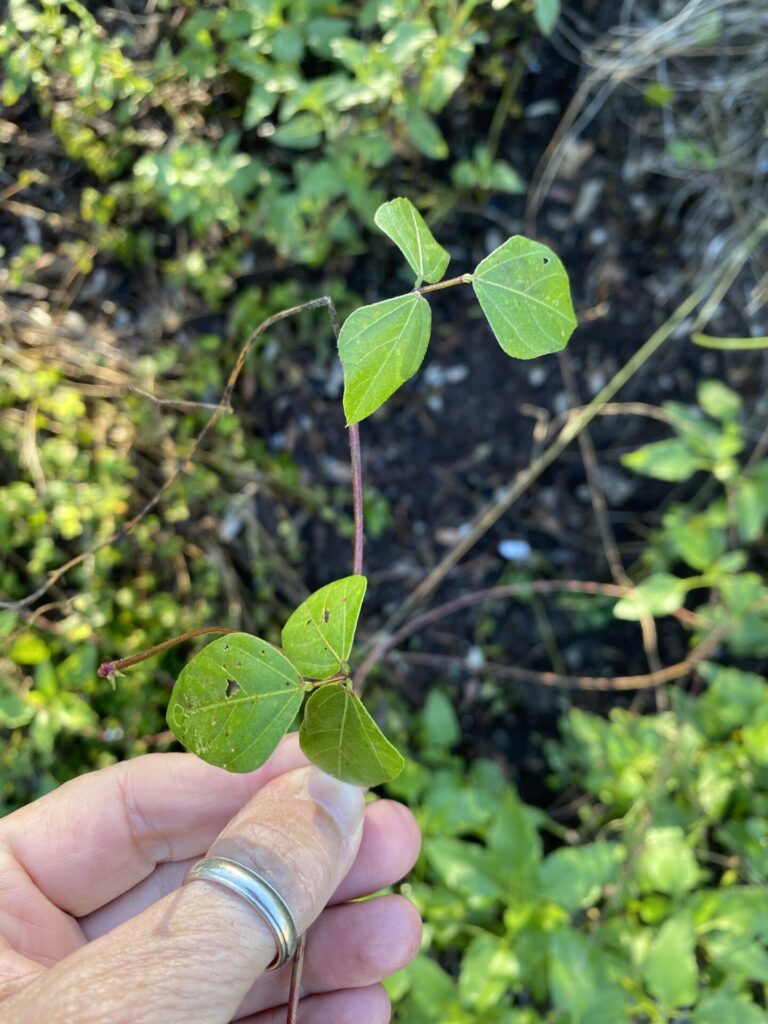
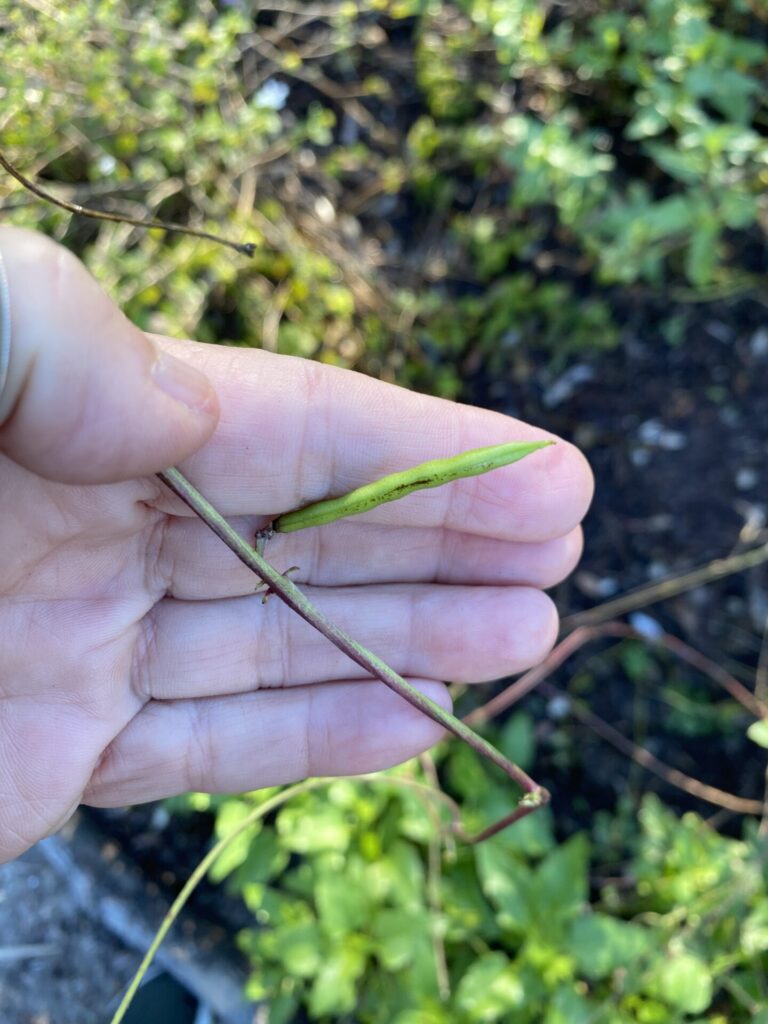
The Cassius Blue butterfly, a rare sight in North Carolina, was seen on the annual Trailing Fuzzybean. The vine’s leaves are grouped in threes, and at maturity, its 2- to 3-inch seedpods turn from green to dark brown. Trailing Fuzzybean tends to wrap around nearby plants. Photos by Carol Peoples
The Cassius Blue is a beautiful tiny butterfly that has only rarely been seen in North Carolina. Her sighting was the third or fourth ever in our state, and the second documented observation this year (the other sighting was also in Carteret County, at Fort Macon State Park). These butterflies are commonly seen in Florida, with less frequent sightings along the east coast and northward to about the Charleston area.The Cassius Blue’s wingspan is only 3/4” – 15/16”. The undersides of the wings are striped, with two eyespots on the margin of each hindwing. Males are pale to bright blue above. Females are bluish-white to white above on basal areas of wings with broad dark borders on the front wings and a dark spot on the rear margin of the hindwing.
Rachel posted her observation on iNaturalist, which caught the attention of Harry LeGrand and Jeff Pippen, authors (along with Derb Carter, Jr. and Pierre Howard) of
Butterflies of North Carolina, South Carolina, Virginia, and Georgia, published in 2024. Within a few days, Jeff Pippen travelled from Raleigh to see the Cassius Blue butterfly.
An Eastern Screech Owl was perched about 3- to 4-feet from where we stood. Photo by Carol Peoples
The following day, members and friends of the Central Coastal Plain Chapter of the North Carolina Native Plant Society visited the native gardens installed by the town of Emerald Isle in October 2024, and then came to my property for a yard tour and social time. As I was chatting with a friend, I noticed something in a tree right beside my porch. I thought it might be a hornet’s nest, but on closer inspection, I was delighted to see there were two juvenile Eastern Screech Owls roosting. Though not rare in our area, it is unusual to see them in the wild due to their excellent camouflage. We all had an opportunity to see the owls from a distance of only about three to four feet. The owls were completely undisturbed by us.
These sightings exemplify the gifts we receive when we conserve natural areas and develop habitats that welcome wildlife into our yards.
Cassius Blue butterfly (Leptotes cassius) on a Trailing Fuzzybean (Strophostyles helvola) on Emerald Isle, North Carolina August 25, 2025. Photo from iNaturalist
Carol Peoples lives in Emerald Isle and is co-leader of the Central Coastal Plain Chapter. She is also a Master Gardener Volunteer through Carteret County Cooperative Extension Service. She’s a native plant advocate and a self-described insect nerd.