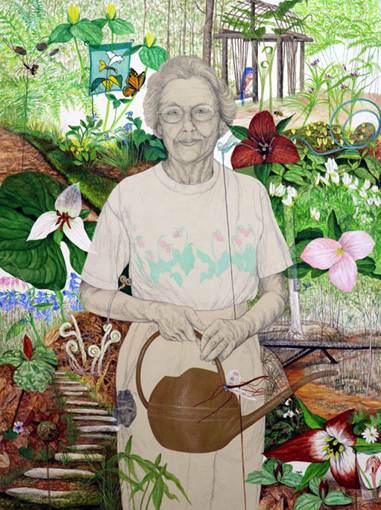
Emily Hine Allen
“Something Greater Than I Am”
The Friendship Garden
It began with one flower.
When Emily Hine Allen and her husband, O.G., moved into their Winston-Salem home in 1954, the wooded property was hardly a garden. Emily later described parts of it as a mess of poison ivy, honeysuckle, and blackberries. Like many young homeowners, she initially imagined familiar garden flowers—marigolds, zinnias, and the other bright plants people commonly planted around their homes—but there was a great deal of shade on the property, and the land had ideas of its own.
One day near the creek, Emily noticed something growing among the tangle. Purple and white flowers rose above the woodland floor. She did not know what the plant was, so she asked.
It was a Showy Orchis, Galearis spectabilis. That question changed the course of her life.
Emily wanted to know more. She took botany classes, learned from people who knew the native flora, went into the field, and began transforming the land around her home into an extraordinary collection of southeastern native plants. The woman who had once needed someone to identify a single orchid eventually became the person other people came to for answers. (Our State)
The garden grew as Emily’s knowledge grew. Plants already living on the property were joined by plants from friends, rescues from places threatened by development, and plants obtained during the years when collecting from the wild was still a common practice. Trilliums became a particular passion. Eventually the garden held an extraordinary collection of eastern North American trilliums, along with ferns, orchids, Oconee bells, shrubs, trees, vines, and hundreds of other native species. Today the preserve contains more than 500 species of plants. (Piedmont Land Conservancy)
But Emily never thought of the garden simply as a collection. She called it her Friendship Garden.
The name described both the plants and the people. Many plants had come from friends, and the garden itself became a place where friendships formed. Visitors walked its paths, botanists came to study, students learned, photographers and artists found inspiration, and native-plant people did what native-plant people have always done when they encounter something interesting: they stopped and talked about it.
Emily was usually right there with them.
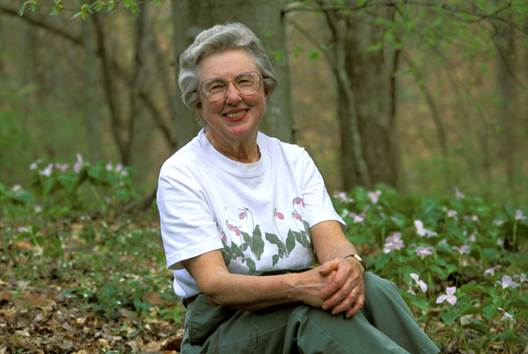
A Garden Made for Sharing
Once you met Emily, Lisa Lofland Gould later wrote in the Society’s memorial to her, you did not forget her. Her enthusiasm for native plants was infectious, but enthusiasm alone did not explain her influence. She had become both a deeply knowledgeable student of native flora and an accomplished native-plant horticulturist. (North Carolina Native Plant Society)
She also loved to teach.
Visitors walking through the garden with Emily might learn how to identify a plant, where its Latin or common name came from, or something about what she cheerfully called the “sex life of plants.” Volunteers learned which seedlings were treasures and which were weeds, and how to care for species that did not always appreciate being moved from the habitats where they naturally occurred. (North Carolina Native Plant Society)
Emily shared the plants themselves just as readily. She called them her “babies,” and over the years those babies traveled. They went home with volunteers, friends, visitors, and fellow horticulturists and took root in public and private gardens far beyond Winston-Salem. (North Carolina Native Plant Society)
That generosity was not new. Society records show Emily bringing creeping wild ginger to share with members as early as 1974. (North Carolina Native Plant Society)
Years later, some of those plants were still making their way through the Society. Jean Woods remembers a plant sale when Mark Rose picked up a sweet shrub in a pot and handed it to her. It had come from Emily’s garden, he told her, and she needed it in her yard. Jean took it home and planted it.
By then Emily was one of the Society’s grand old ladies, someone Jean knew but not well. Yet one of Emily’s plants had traveled from her Friendship Garden, through another member’s hands, and into Jean’s garden. It was an ordinary transaction at a Society plant sale, the sort of thing that happened all the time. That was precisely what made it significant. The plants moved through the community just as the knowledge did.
There was an informality to all this sharing that was characteristic of the Society. Plants passed from hand to hand and garden to garden, carrying with them memories of the people who had grown them. In Emily’s garden, those relationships became part of the landscape itself.
She was not, however, a quiet gardener content to remain at home tending her woodland. Emily went looking for plants. And she could be determined about it.
Going After the Plants
In 1979, a young graduate student named Ken Bridle came to Emily’s garden with a botany class. The two became friends through the Wild Flower Preservation Society. Emily wanted to see and learn more plants in western North Carolina; Ken was interested in plant physiology and eager to explore. They reached an arrangement. Ken would drive, and Emily would pay for his lodging.
Off they went—to the Smokies, the Balsams, Nantahala National Forest, and other places where Emily might find something she wanted to see.
Ken remembers one particular trillium expedition. He was driving up a dirt road through a series of switchbacks when he suddenly heard the car door slam.
Emily had jumped out. The car was still moving. She was about sixty-five years old. Whatever Emily had spotted apparently could not wait for the car to stop. (Our State)
It is easy to picture her: the same woman who had once stopped to look at a Showy Orchis in her own neglected yard was still stopping for plants decades later, only now she knew considerably more about what she was seeing. Curiosity had become a way of life.
Tending More Than a Garden
Emily brought that same energy to the North Carolina Wild Flower Preservation Society.
She served as corresponding secretary from 1966 to 1968, became president in 1978, served through 1982, and then continued as a trustee and longtime adviser to the board. When the Society honored her at its Spring 2000 meeting, it recognized not only those formal offices but her years of faithful attendance and counsel.
Her presidency came at an important time for native-plant conservation in North Carolina. In 1979, the state finally enacted the Plant Protection and Conservation Act, establishing legal mechanisms for protecting specified threatened and endangered plants. Emily was appointed to the new Plant Conservation Board as a representative of a North Carolina conservation organization, while Ken Moore served on its Scientific Committee.
Emily understood the importance of that development. Writing as Society president in 1980, she explained that North Carolina previously had no agency specifically responsible for protecting endangered and threatened plants. She was also concerned about showy species vulnerable to exploitation, including orchids, lilies, trilliums, ginseng, Venus flytrap, and particularly Pink Lady’s-slipper, which was frequently dug despite being notoriously difficult to transplant successfully.
Her presidency also helped secure the Society itself. When the organization obtained its nonprofit status in 1981, Emily was president. (North Carolina Native Plant Society)
Even after her formal leadership years were over, she kept paying attention. At a 2002 board meeting, Emily brought an article about exploding deer populations and their effect on wildflowers and birds and urged conservation organizations to bring the issue before the public. The gardener and the conservationist were never very far apart.
A Living Collection
By the time Emily’s garden was mature, it had become something unusual even among native-plant gardens. It was beautiful, certainly, but it was also biologically valuable.
The Society’s own habitat certification records describe a 5½-acre property devoted entirely to North Carolina native plants, with canopy and understory trees, shrubs, ferns, woodland flowers, grasses, vines, groundcovers, mosses and lichens. Emily practiced invasive removal, minimized chemical use, encouraged beneficial insects, left leaves where possible, reduced lawn, and used other practices that today would be recognized as ecological gardening. Most revealing of all, when the application asked whether she would allow people to visit, the answer was yes—by appointment.
Of course she would. The garden was meant to be shared. The question that eventually confronted Emily, however, confronts every gardener who spends a lifetime creating something.
What happens to the garden when the gardener is gone?
Emily understood the danger particularly well. A garden containing rare and unusual plants could disappear quickly after a property changed hands. Decades of knowledge could vanish with it. She began thinking about another possibility.
“Something Greater Than I Am”
In 2000, Emily and O.G. Allen donated a conservation easement protecting the property through Piedmont Land Conservancy. The agreement was unusually forward-looking. The land was not simply to remain undeveloped; the garden was to continue as a native-plant sanctuary, an educational resource, and a repository of native plants and seeds that could supply botanical gardens without requiring plants to be taken from wild populations. (Piedmont Land Conservancy)
Emily had come to understand that what she had created no longer belonged only to her.
She put it simply:
“Here is something greater than I am and it’s a legacy that I can pass on to others.” (Piedmont Land Conservancy)
That may have been the most important thing she ever planted.
A group of Friends volunteers formed to help care for the garden. Emily taught them what she knew, and they learned the peculiarities of individual plants and the rhythms of the place. Shortly before her death in 2015, the Allen family donated the garden and residence to Piedmont Land Conservancy, ensuring that both could continue serving the educational purpose Emily envisioned. (Piedmont Land Conservancy)
The gardener had made provisions for the garden to live without her.And then, in 2015, Emily died at eighty-eight.
The Garden Without Emily
For people who knew her, it must have been difficult at first to imagine the Friendship Garden without Emily in it.
Lisa Gould remembered that on almost any visit, Emily could be found on her hands and knees among the plants—pulling weeds, moving a stray plant, tending something temperamental, or simply enjoying being outside among what Gould beautifully described as her friends, both plant and human. (North Carolina Native Plant Society)
Her daughter Marty Cook remembers her mother still working in the garden into her eighties, often in green-and-white gingham shorts during the heat of summer. She worked unless the weather made working nearly impossible. The garden was simply where Emily was. (Our State)
But the garden did continue without her. Volunteers kept coming. They weeded, planted, maintained trails, learned the plants, taught visitors, and passed their knowledge to new volunteers. Open Garden Days brought people beneath the woodland canopy. Classes and workshops continued. Students came. The house and garden increasingly became the educational center Emily had imagined. (Piedmont Land Conservancy)
The Friendship Garden remained a friendship garden. And the learning continued.
Another Young Woman Asks Questions
In the summer of 2026, Wake Forest University student Leyla Herrera (’27) came to the Emily Allen Wildflower Preserve to do field research on ferns.
She was asking questions very different from the question Emily had asked when she first found that Showy Orchis. Leyla was measuring photosynthesis, water use, and other physiological traits to understand how ferns function in different environments, where they can thrive, and the role they play in shaping forest ecosystems. But there is something wonderfully familiar about the scene. A young woman is in Emily’s garden, looking closely at plants, wants to know how they thrive there.
Emily’s journey had begun because she encountered one plant she could not name and became curious. More than half a century later, another young woman was using the place Emily created to ask her own questions of plants.
The questions had become more sophisticated. The instruments had changed, but curiosity had not.
Emily’s daughter Marty eventually came to understand that what her mother had taught her in that garden went beyond botany or horticulture. It was, she said, “a philosophy of living”: remain curious, remain capable of wonder and joy—and share. (Our State)
That philosophy is still visible in the garden.
Emily’s plants continue to bloom. Her “babies” grow in other people’s gardens. Volunteers still care for the paths and teach visitors. Botanists and gardeners still come to see what grows there. Students still arrive with questions.
A Showy Orchis once stopped Emily Allen in her tracks. She spent the rest of her life following where that question led. Then she made certain there would be a place where someone else could ask the next one.
Emily spent a lifetime learning from her garden. Her greatest gift was making sure the garden could go on teaching without her.