
By Anna Helvie reporting for Native Plant News Winter 2025
By the time you read this article, you have probably been shopping while surrounded by kilometers of plastic holly, and being urged to “deck your halls with boughs of holly” umpteen times. After all, ‘tis the season! However, while holly is a famous symbol of the winter holiday season, our native American Holly is much more. It’s a plant that is beneficial for wildlife and beautiful in our home landscapes all year round. Let’s take a closer look at this iconic tree.
The American Holly tree is known botanically as Ilex opaca. All true hollies around the world belong to the genus Ilex — which, oddly enough, was named for a European evergreen oak with similar leaves! The Ilex genus numbers between 400 and 500 species worldwide. Here in North Carolina, we have fourteen native Ilex species. Besides American Holly, you may have heard of Yaupon (Ilex vomitoria), Winterberry (Ilex verticillata), and Inkberry (Ilex glabra), three other native hollies that have found widespread popularity in landscaping. But this article will focus on the only NC native holly species that grows into a full tree, Ilex opaca, American Holly, also known as Christmas Holly and White Holly.
Buyer beware
NCNPS members should be aware that there are two popular non-native hollies in the nursery trade—Chinese Holly (Ilex cornuta) and Japanese Holly (Ilex crenata)—which are on the NCNPS Invasive Plant list. Please make sure you are purchasing our native American Holly!
American Holly is the only holly tree in North Carolina that closely resembles the holly of European Yuletide lore (Ilex aquifolium). European immigrants easily recognized the similarities between their holly and American Holly. Both feature leathery, evergreen leaves with edges that are curved into sharp points.

European and American hollies have important differences
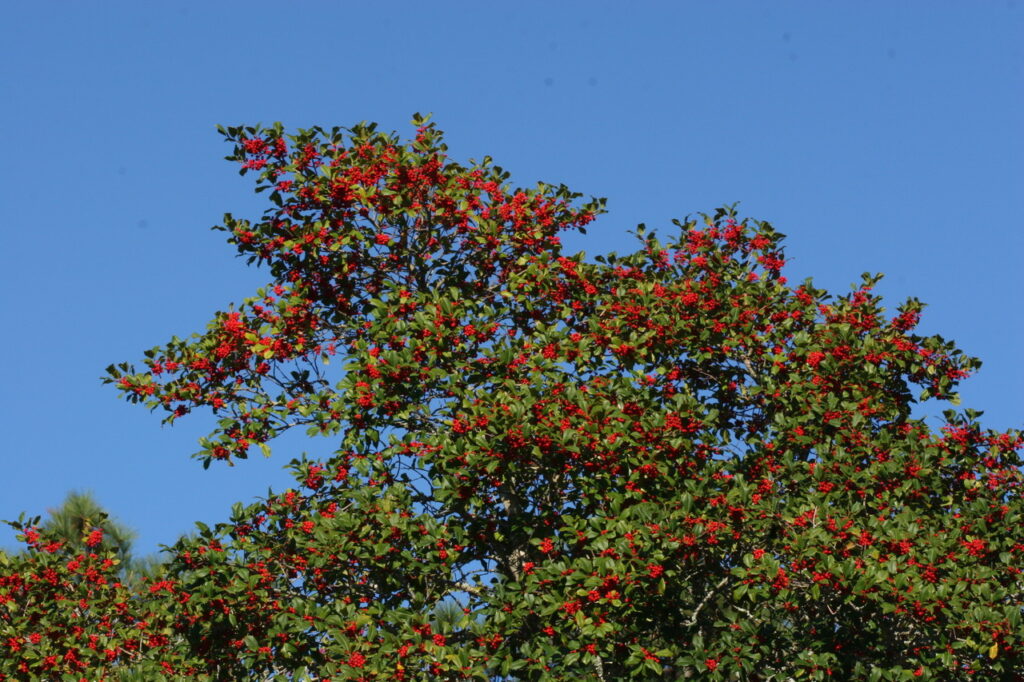
Both have gray bark, and both have red “berries” — actually, drupes — that feed numerous bird and animal species in the winter. However, there are important differences. American Holly leaves and berries are less glossy than the European holly. In fact, the “matte finish” of American Holly leaves led to the species name, opaca, which means “dull” or “opaque” in Latin. American Holly leaves are lighter in color, and the red drupes develop from spring flowers that blossom on tiny, single stalks coming off of the twigs of the current year’s growth.
American Holly is dioecious: female and male flowers grow on separate trees, and you need a male holly within about 200 feet to pollinate female holly flowers. Holly flowers are usually tiny, mostly four-petaled, whitish-green, somewhat fragrant and, while not showy individually, can be eye-catching en masse. Bloom time in our bioregions is usually April. Both male and female holly flowers provide abundant nectar, while male holly flowers offer protein-rich pollen that nourishes native bee colonies. American Holly blooms attract many species of native bees, wasps, flies, moths, and other pollinating insects. Holly also serves as a host plant for the Henry’s Elfin butterfly (Callophrys henrici).
Female holly flowers that have been pollinated successfully develop into the bright red drupes that are relished by 29 species of birds, including robins, cedar waxwings, bluebirds, wrens, bobwhite quail, mourning doves, and wild turkeys. Each drupe has four seeds surrounded by yellow flesh and the characteristic red skin. American Holly provides protective nesting for mockingbirds, robins, veeries, cedar waxwings, and several other birds. Squirrels, opossums, raccoons, and mice enjoy the drupes also; in the wild, bears and deer will feed on the berries. Holly’s spiny leaves usually deter deer. While these wildlife species can feast on holly leaves and berries, please note that American Holly is toxic to humans, dogs, and cats, resulting in gastrointestinal distress (but rarely anything more serious).

American Holly grows abundantly in every county throughout North Carolina, except at the higher elevations, and it tolerates a wide range of conditions. You will find American Holly in Longleaf Pine forests and mixed hardwood forests alike; on mesic soils (soils that are moderately moist), and in moist bottomlands. In the wild, it is content to grow in shade, and you will often see it as a sparsely-branched understory shrub or tree in forests.
American Holly bark often displays orange, red, white, or tan patches on their trunks. In the forest, the eye-catching patches can often be spotted from a distance. These patches are not traits of the tree but are lichens that often grow on the bark. Some lichens also create black circles on the bark. These lichens are harmless to the tree but add considerable visual interest.

Under optimal conditions in the wild, and in the home landscape, American Holly may grow to as much as 60 feet, although as a slow grower, it takes its time getting there. American Holly deserves a place in our urban and suburban environments, and can perform very well there. A sunny-to-part-shade location will deliver maximum branch and leaf density. Plant your holly in neutral to slightly acidic, well-drained soil. Give it some protection from frigid winter winds and hot afternoon sun. Hollies like moisture but do not tolerate standing water. It will not tolerate limestone-based or alkaline soils.
American Holly grows in a pyramidal shape, with branches reaching to the ground, although in the landscape the tree is sometimes “limbed up” to allow view of the attractive light gray, sometimes warty bark. With a maximum height of 40 to 60 feet, and a spread of 10 to 20 feet, this holly is better suited for medium to large yards. If your yard cannot accommodate an American Holly, consider ways for them to be installed in commercial landscapes.

Straight species versus cultivars
Plantsmen have bred numerous American Holly cultivars. Some are smaller than the straight species (a plant in its natural form as it exists in nature), and some have yellow berries or variegated foliage. Cultivars are controversial in the native plant world. We now know that the more a cultivar deviates from the straight species, the less likely it is to be accepted or useful as a nectaring, food, or host plant for native insects and animals. If you consider choosing a cultivar for your landscape, choose one with only minor modifications, such as slightly less height or a more compact habit, over a cultivar that changes the color, size, or shape of flowers, fruits, and leaves.
I am blessed to have a large American Holly in my yard planted by the previous owners 50 years ago. Despite being located under powerlines and “topped” every few years, this tough old tree faithfully blooms and berries every year and continues to offer beauty for my eyes and nutrition for many birds and bees.
Sources