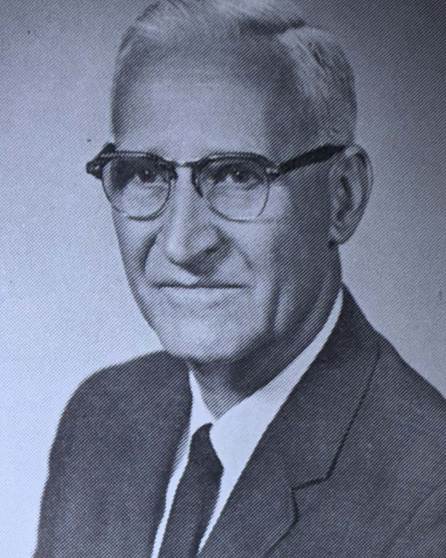
Charles F. Moore
“Acres of It.”
He Knew the Mountains.
In 1916, twelve-year-old Charlie Moore saw the mountains for the first time. He had grown up in Mooresville, and when his father announced that the family was moving west, Charlie did not quite know what mountains were. His schoolmates were happy to explain, although they had never seen them either. Charlie came away convinced that mountains rose sheer up and down, that trees grew from their sides at right angles, and that a rattlesnake waited behind every tree.
The journey did little at first to reassure him. The train climbed through Old Fort after the great flood of 1916, past twisted rails and scarred river valleys, through dark tunnels filled with coal smoke and cinders. But when the train reached Ridgecrest and Charlie looked out at the mountains, everything changed. He knew, he remembered more than seventy-five years later, that this was “the promised land.” He felt, as he put it, “like a mule that had been wintered in the barn” and suddenly turned loose. “I have never gotten over that first impression of the mountains,” he said in 1992. “I still find it interesting and every day I find more interest. Never get tired and never learn everything.”[1]
He never did get over it. For the rest of his long life, the mountains became the landscape he explored, learned, photographed, shared, and loved.
For decades, Society members traveled to Brevard knowing that a day with Charlie meant more than seeing beautiful wildflowers. It meant entering the mountains with someone who knew them intimately. Charlie had spent a lifetime exploring the coves, ridges, streams, and forests of western North Carolina. He knew where the spring ephemerals emerged, where orchids hid, and where rare wildflowers quietly returned year after year. Walking with Charlie, people soon discovered that every bend in the trail held another story.
His knowledge came not from books alone but from countless days in the woods. As a longtime Duke Power employee, Charlie explored much of western North Carolina while the region was changing rapidly. Along the way he photographed hundreds of native plants, documented forests and wildflowers, and developed an extraordinary familiarity with the flora of the Southern Appalachians. Professional botanists sought his help because Charlie knew where the plants actually lived.
Charlie had been walking those mountains since boyhood. He remembered going up King’s Creek to Cat Gap and on to Cedar Rock on Sunday afternoons, provided he could get home in time for church. In those days, he said, people did not “hike.” They simply went for a walk. Decades later he was still doing much the same thing, although by then botanists, Society members, students, and friends were walking beside him.
Charlie was also a storyteller, and his stories rarely traveled in straight lines. Neither, apparently, did Charlie. During the 1992 oral-history interview he stopped himself at one point and admitted, “I’m sorta wandering, but I sorta wandered around the mountains anyway.” One memory opened into another—a childhood walk, an old Brevard character, an orchid expedition, a visiting botanist—and before long the listener had wandered a considerable distance with him. His humor was gentle and usually turned first on himself. Asked at eighty-seven to tell about himself, he replied that it would take only a few minutes and announced that on his next birthday he would be “a little over 21.”
One story captures Charlie perfectly. In the early 1950s, Duke botanist P. A. Davies, then head of the Biology Department at the University of Louisville, was searching for one of North Carolina’s most celebrated plants, Shortia galacifolia. Davies asked Charlie if he knew where it grew.
Charlie’s answer was wonderfully simple: “Acres of it.”
That brief reply, later recounted in Charlie’s delightful essay “The Shortia Train,” began a friendship that lasted for years. Together they explored the mountains in search of Shortia, sharing discoveries, stories, and an enthusiasm that made every outing feel like an adventure. Charlie told the story with characteristic humor, never presenting himself as the expert, but simply as someone fortunate enough to know the mountains well enough to introduce others to their treasures.
That was Charlie’s gift. He never seemed interested in impressing people with what he knew. He wanted them to see what he saw.
His curiosity ranged far beyond the mountains around Brevard. He traveled in search of orchids in Florida’s Fakahatchee Swamp, in Michigan bogs and dunes, and elsewhere in North America. He traveled in Europe and welcomed visiting botanists and naturalists to western North Carolina. A British researcher working on a documentary about continental drift stayed with Charlie while photographing Shortia, whose North American species and Asian relatives offered a botanical clue to the ancient relationship of continents.
Yet the most revealing thing Charlie said about these experiences was not where he had gone or whom he had known. It was what he had learned from them. “I learned from every one of the men that I’ve been with, I learned something I didn’t know,” he said. “And I can always learn something from almost anybody that I go out with.” For a man who knew the mountains so well that professional botanists sought him out, it was a striking statement. Charlie’s knowledge remained open-ended. There was always another plant, another place, another person from whom something could be learned.
He shared that knowledge just as freely. Charlie recalled giving programs at Clemson, UNC Asheville, Brevard College, in Memphis and Florida, and to Boy Scouts, garden clubs, and countless other groups. A Brevard newspaper profile described the unusual range of his gift: he could fascinate a lay audience and also speak seriously with experts. His woodland sanctuary near Brevard—the place he simply called “the farm”—welcomed both eminent botanists and local friends who came because they enjoyed being among the plants.
Society members experienced that generosity firsthand. By the early 1970s, Charlie’s more than 300-acre property near Brevard had become one of the Society’s favorite destinations. Trails wound through woodlands rich with native plants, many carefully protected and others thoughtfully introduced over the years. Annual field trips brought members back again and again, while countless friends simply stopped by whenever they found themselves in the mountains. Visitors came expecting a field trip. They left feeling as though they had spent the day in the company of an old friend who happened to know every flower along the path.
Charlie’s mountain walks became legendary. Members explored Pisgah Forest, searched for spring wildflowers, and learned to notice the subtle differences between habitats that most hikers simply passed by. He had an uncanny ability to make people slow down. A trillium was never just a trillium. It belonged to a rich cove forest shaped by moisture, geology, shade, and time. A mountain stream was not merely beautiful. It explained why certain wildflowers flourished there while others grew only a ridge away.
Charlie’s explorations with Davies led to another important discovery. While searching the Catawba River watershed, they found a population of Shortia that differed from the better-known mountain plants. It was smaller, grew in dense clumps, had more spatulate leaves, and possessed a noticeably shorter style. Charlie and Davies recognized it as distinct and referred to it as Shortia galacifolia var. daviesii. Today it is recognized as Shortia galacifolia var. brevistyla—the same rare Shortia now protected at the Carraway Tract, where the Society has helped preserve its habitat. A discovery made during those mountain explorations would eventually become part of the Society’s own conservation story.
Charlie delighted in telling the story of the famous “Shortia Train,” a special excursion celebrating the opening of the Toxaway Hotel. He remembered the Pullman and dining cars overflowing with Shortia. The flowers filled wall vases, decorated dining tables, and were draped around the windows. To Charlie, it was a wonderful story—not because famous people rode the train, but because one remarkable native wildflower was celebrated with such enthusiasm. It was exactly the sort of story he loved to tell: a reminder that North Carolina’s native plants had long inspired wonder in those willing to notice them.[2]
Charlie’s friendships within the Society reflected that same generosity. Charlie Moore, Larry Mellichamp, and Tom and Bruce Shinn each brought different gifts to the Society. Larry shared the disciplined curiosity of the botanist and teacher. Tom and Bruce delighted in propagating native plants and helping others succeed in growing them. Charlie brought the mountains themselves. Together they formed a remarkable generation of teachers who never seemed to compete with one another. Instead, each expanded the Society’s understanding of North Carolina’s native flora, reminding members that knowledge grows richer when it is shared.
The 1986 newsletter describes Frank Bell, Charlie Moore, Larry Mellichamp, Harry Phillips, and Ray Noggle gathering to share stories about the Society’s early years and the evolution of the Shinns’ famous garden. One can almost hear the conversation drifting naturally from history to native plants, from propagation to memorable field trips, from old friends to new discoveries. In many ways, those conversations captured the very heart of the Society.[3]
The friendship between Charlie and Larry Mellichamp extended well beyond Society meetings. Charlie took the younger botanist into the mountains and showed him places he had come to know through decades of exploration. Years later, Larry remembered Charlie simply as the man who “knew all the good sites around Brevard.”
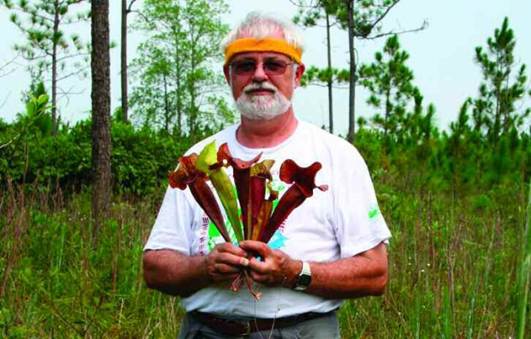
Larry with Sarracenia ×charlesmoorei
In 2008, twelve years after Charlie’s death, Larry gave that friendship a permanent botanical memorial. While working on the pitcher plant family for the Flora of North America, he formally described a rare natural hybrid between Sarracenia purpurea and Sarracenia jonesii. Larry named it Sarracenia ×charlesmoorei, explaining that Charlie had been a longtime friend who had shown him many interesting plants in the mountains and was especially known for his knowledge of Shortia and Sarracenia jonesii.[4]
It is difficult to imagine a tribute Charlie would have appreciated more. The man who had spent so many years taking other people into the mountains to show them plants now had a mountain plant bearing his name.
Visitors often remember Charlie as a guide, but he was also a gifted storyteller, photographer, teacher, and student to the end. His photographs documented hundreds of Southern Appalachian wildflowers, preserving not only the beauty of individual plants but also the landscapes they inhabited. During anniversary celebrations he joined other longtime members in recounting stories of the Society’s early years, helping preserve memories that otherwise might have been lost. Like the trails he loved, those stories connected one generation to the next.[5]
Looking back, Charlie Moore’s legacy cannot be measured simply by the plants he found or the photographs he took. It lives in the countless people who learned to love the Southern Appalachians because he took the time to walk beside them. The boy who first looked out at the mountains in 1916 and thought he had reached the promised land was still learning from them more than seventy-five years later: “Never get tired and never learn everything.”
Like the best teachers, Charlie never asked people to follow him. He simply invited them to look more closely.
He taught generations of members that every mountain has stories waiting for those willing to walk slowly enough to hear them.
Portrait: Charles F. Moore
1. Charles F. Moore oral-history interview, 1992. Principal source for Moore’s childhood arrival in the mountains, his early walks around Brevard, his humor, his travels, and his reflections on lifelong learning.
2. Charles F. Moore, “The Shortia Train,” and related Shortia material in the North Carolina Wild Flower Preservation Society Journal/Newsletter, Spring 1982. Source for Moore’s Shortia stories and his work with P. A. Davies.
3. North Carolina Wild Flower Preservation Society Newsletter, 1986, account of Frank Bell Sr., Charlie Moore, Larry Mellichamp, Harry Phillips, and Ray Noggle sharing stories about the Society’s early years and the Shinn garden.
4. Larry Mellichamp’s published botanical work on Sarracenia ×charlesmoorei, 2008, named the natural pitcher-plant hybrid in honor of his longtime friend Charles F. Moore.
5. Contemporary Brevard and Duke Power profiles of Charles F. Moore describe his work for Duke Power, extensive photography, woodland sanctuary, public programs, and reputation among both professional botanists and local naturalists.