Where It All Began
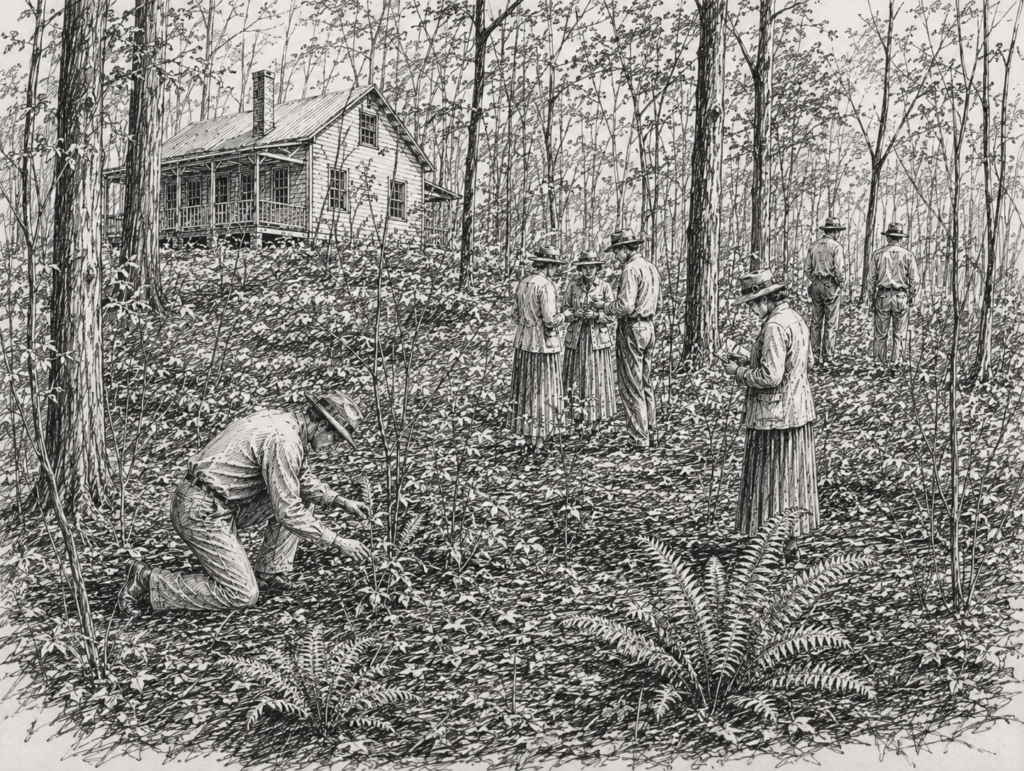
On April 29, 1951, people gathered at Smithwin Farm near Chapel Hill because of their interest in the plants that grew naturally in North Carolina. They were botanists and gardeners, teachers, members of garden clubs, university professors, and people who simply loved wildflowers. What united them was a fascination with the native plants that were largely ignored by the nursery trade. They wanted to know where these plants grew, what they looked like, and how they might be cultivated.1
But they wanted something more. They believed these plants were worth preserving.
That conviction was so central to their purpose that they placed it in the Society’s name. They did not call themselves a wildflower club or a botanical society. They became the North Carolina Wild Flower Preservation Society. Reading the earliest newsletters, one is struck by how naturally the members spoke of preservation. They worried about disappearing wildflowers, shrinking habitats, and the loss of places where native plants flourished. Preservation was not simply one of the Society’s activities—it was its identity. The founders believed North Carolina’s native plants needed people who would understand them, appreciate them, and, when necessary, speak on their behalf.
Smithwin Farm was owned by Herbert and Conner Smith, who delighted in the native flora surrounding their home. Their wooded property was large enough to wander for hours, discovering plants in their natural setting. It was a fitting place for people who shared a curiosity about the natural world to gather.
The meeting itself was the vision of two women, Mary Tate Graham of Ramseur, Sixth District Director of the Garden Clubs of North Carolina, and Conner Smith, whose hospitality made Smithwin Farm available for the gathering.
When we first located the records of that meeting, both women appeared only under their husbands’ names—Mrs. A. C. Graham and Mrs. Herbert Smith—as was customary at the time. Through later newsletters, archival research, and patient detective work, their identities gradually emerged. It seemed only fitting that, in telling this story seventy-five years later, they should once again be known by their own names: Mary Tate Graham and Conner Smith.
The group met to discuss plants, explore natural areas across the state, and share their experiences and knowledge. It did not matter whether someone was a beginning gardener or a distinguished botanist from the University of North Carolina. Everyone learned from one another. Knowledge was shared freely, as were seeds, plants, and stories of places where unusual species could be found.
It is probably no coincidence that the Society was born near Chapel Hill. The University of North Carolina already had one of the South’s leading botany departments, and Duke University, only a few miles away, was home to another distinguished botanical tradition. Faculty members, students, and professional botanists became active participants in the Society from its earliest years. Over time, the North Carolina Botanical Garden would become one of the Society’s closest partners, providing a gathering place, educational programs, speakers, and generations of botanists who enriched the Society’s work. Chapel Hill was more than the place where the Society began; it became one of the places that continually nourished its growth.
Information and plants were exchanged, but something else happened during those early years. Members came to appreciate plants not as isolated specimens but as parts of living communities. They noticed that a hillside filled with wildflowers one spring might be altered—or gone—the next time they visited. Although they did not yet use the phrase habitat loss, they were witnessing it.
In 1952, only a year after the Society was founded, one of its programs focused on North Carolina’s native lilies and concern over their dwindling numbers. Something beautiful was becoming less common. Their attention was already turning toward what we would today call conservation, although they would have used another word—preservation.3
By 1955, the Society was addressing roadside erosion and the preservation of native vegetation during highway construction. In 1956, it established a Conservation Committee that included B. W. Wells, O. M. Freeman, H. R. Totten, and Hollis Rogers.
Rogers also challenged a practice common in education at the time: collecting wildflowers simply to identify them. He urged teachers to take students outdoors instead, where they could learn to appreciate plants in their natural surroundings. It was a remarkable insight. Education could become another form of taking, or it could teach people to see.
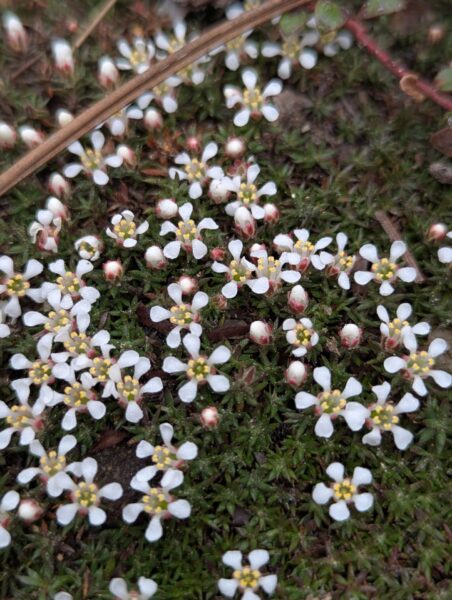
Larry examines Little-leaf Pixie-moss with Lyne Askins Photo by Will Stuart………………………………………………………………………….Pyxiemoss (Pyxidanthera barbulata), a rare, tiny flowering plant Sandhills
That same year another challenge emerged.
In the Sandhills, a small evergreen known as Pixie-moss (Pyxidanthera barbulata) appeared likely to lose its habitat. It was hardly a spectacular plant. Creeping close to the ground with delicate pink-white flowers, it was easy to overlook. Yet Society members understood its importance. The Babcock Lumber Company offered four or five acres to protect the site.4
By modern standards it was a tiny tract of land. Yet the principle was enormous. To preserve the plant, the place had to be preserved as well.
Accepting the land required the Society to become something more than an informal gathering of people with shared interests. It needed the legal ability to own property. The effort to save Pixie-moss helped propel the Society toward incorporation.
The land was never secured.
There is a temptation in an anniversary history to hurry past unsuccessful efforts, as though enduring organizations are built only on victories. The Pixie-moss story deserves better than that. It reminds us that preservation has never been easy. The Society could not save every place it loved. But the effort changed the way its members thought about native plants. They were no longer protecting individual flowers alone. They were beginning to understand that plants and places could not be separated.
That realization would shape everything that followed.
As the decades passed, the Society would advocate for parks and natural areas, oppose destructive projects, promote native plant propagation, establish scholarships, support scientific research, create stewardship funds, protect land through conservation grants, organize local chapters, and encourage thousands of North Carolinians to create native habitats in their own communities.
The methods changed because North Carolina changed. The mission did not.
For seventy-five years the Society has found new ways to fulfill the same promise first made at Smithwin Farm: to preserve, understand, and protect North Carolina’s native plants and the places where they grow.
SMITHWIN FARM
by Nell Lewis
Members of the NCWFPS are going back home, back to Smithwin
Farm for the 25th anniversary of this organization that has meant so
much to so many people. It was there, on Apri129, 1951, that Herbert
and Conner Smith were host to a small group of people who, like
themselves, wanted to “preserve our native wildflowers, learn more
about them, and just simply enjoy their beauty.”
“It was such a struggle, those first two or three years, to keep the
Society going, but what it was in the beginning is not important; what it
is now is what is glorious,” Conner Smith says with the pride of a
mother who has watched her child grow from infancy to enriched
adulthood. And during the intervening years the treasures from
Smithwin Farm have reached out to thrive and bloom in gardens from
the towering peaks of our lovely state on down to its restless shores.
It would be unusual, if not impossible, to visit the Smiths and go
away empty-handed. They graciously share the native plants that grow
in abundance across the woodlands and along the creeks of their estate,
as well as the nursery stock they purchase and carefully propagate
which often includes rare species in limited quantity. The only price
they ask is that the gift be properly cared for and, as it multiplies, shared
with someone else.
Smithwin flowers, trees and shrubs are also flourishing in our state’s
botanical gardens and close by nature trails in many of its parks.
Dedicated conservationists, the Smiths propagate plants by the usual,
as well as experimental methods and their enviable expertise is passed
on to both amateur and professional gardeners along with seeds,
cuttings, grafts, bulbs and plants.
Looking back over 25 years, Conner says “the older we grow the more
Herbert and I realize that the NCWFPS has been the highlight of our
lives.” And when we, as members of this organization that was born at
Smithwin, look out across our gardens it is with deep appreciation for
the Smiths who have given so generously of their time, talents and
flowers.
Gardens are not really made of just plants; as each flower blooms it is
a reminder of another time, another place- the echo of a warm hello
from friends who make a garden a place of beauty.
Nell Lewis is a columnist for the Greensboro News and Record and
garden designer who served as the Society publicity chairman for many
years. Reprinted from the Spring 1976 newsletter